Worker Story 1: Fatima – refugee office worker
Fatima – Refugee Office Worker
Estimated time: 10–12 minutes (including reflection).
Read Fatima’s story to see how a real worker faces a barrier and takes small steps
toward a new opportunity.
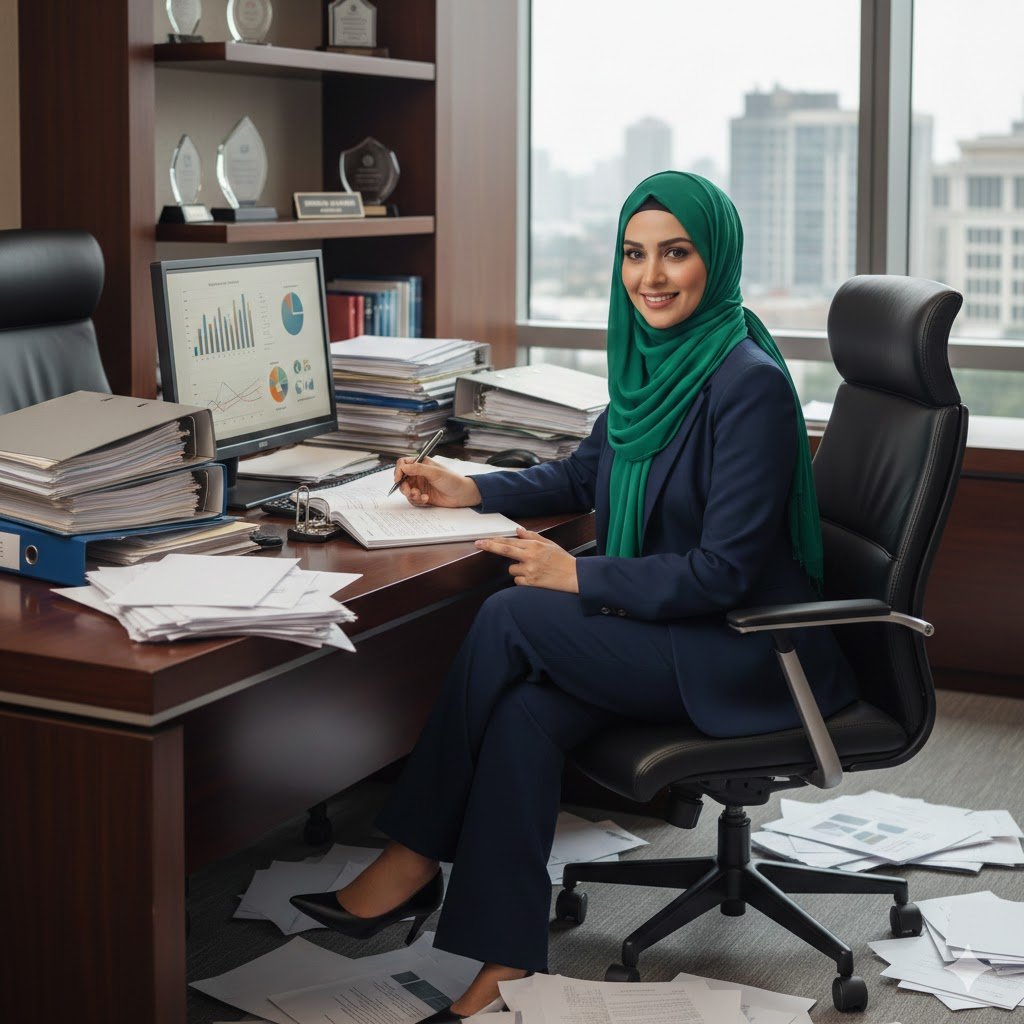
Key words for this story:
Click or press Enter/Space on each word to open it. You do not need to memorize everything. These words are here to support you while you read.
refugee
A person who had to leave their home country because it was not safe (for example, war or persecution) and is now living in another country.
Work example: A refugee may have many skills but may face extra barriers with documents or recognition of their experience.
local diploma
A certificate or degree from a school or university inside the new country.
Work example: Some employers say they prefer a local diploma and do not understand degrees from other countries.
CV
A written document (similar to a résumé) that shows your work experience, education, and skills.
Work example: Fatima updates her CV to show her office skills from before she became a refugee.
work permit
An official document that gives you legal permission to work in a country.
Work example: Without a work permit, some employers refuse to give a fair contract.
transferable skills
Skills you can use in different jobs or fields (for example, organizing, problem-solving, customer service, using email).
Work example: Fatima’s organizing skills from her old office job are transferable skills in her new country.
discrimination
Unfair treatment of a person or group because of things like nationality, gender, religion, or age.
Work example: If a company never interviews refugee candidates even when they are qualified, that can be a form of discrimination.
Level A reading – Fatima’s story (shorter version)
If you want more support with vocabulary and shorter sentences, start with this version.
Before she became a refugee
Before the war, Fatima worked as an office assistant in her home country. She managed appointments, answered emails, and helped visitors. Her supervisor often said she was organized and calm. Fatima felt proud of her work.
Starting again in a new country
When she arrived in the new country as a refugee, everything changed. She did not have a local diploma, and her old papers were not easy to translate. For two years, she worked in a small shop, standing all day and helping customers.
In the shop, people sometimes spoke quickly. When she did not understand, a few customers made jokes about her accent. Fatima started to think, “Maybe I cannot work in an office again.”
The myths she believed
Fatima heard many messages from people around her:
- “As a refugee, you should just be grateful for any job.”
- “No company will trust your experience from another country.”
- “Without a local diploma, you cannot get an office job.”
These ideas became strong in her mind. She started to believe that her previous experience did not matter and that she would never have a “professional” job again.
A small training program
One day, a friend told Fatima about a free training program for refugees who had worked in offices. At first, Fatima thought, “This is not for me. My English is not good enough.” But the friend encouraged her to try one session.
In the training, the coach helped the group list their skills from past jobs. Fatima wrote: “organizing calendars, talking to clients, solving small problems, using email.” The coach said, “These are strong transferable skills. They still matter here.”
Updating her CV and learning her rights
With help, Fatima updated her CV. She added a short summary at the top and clear bullet points about her office tasks. The coach also explained basic labor rules about work permits and contracts.
For the first time, Fatima saw that her story was not only about loss. It also showed responsibility, patience, and learning in a new country.
Her first interview in the new country
After a few weeks, the program helped her apply for an entry-level office job. When she received an interview email, she felt both excited and afraid.
She practiced answering simple questions: “Tell me about your experience,” “Why do you want this job?” She also practiced one short story about a time she solved a problem with a visitor in her old office. Even before the result, she thought, “Maybe I do belong in an office again.”
Level B reading – Fatima’s story (extended version)
This version adds more detail and more vocabulary. Try to guess new words from context first, then confirm in a dictionary like Cambridge or Merriam-Webster.
An office professional in a different life
In her home country, Fatima was known as “the person who keeps everything running.” As an office assistant in a busy clinic, she managed the schedule, filtered phone calls, and welcomed patients. Her supervisor often praised her qualifications and calm manner under pressure.
When conflict forced her family to leave, Fatima crossed a border and became a refugee overnight. Her documents were complete but not fully recognized. Her clinic experience did not appear in any local system. On paper, she looked like a beginner.
New work, new labels
In the new country, the first job she found was in a small clothing shop. The work was hard and the pay was low, but it was something. Customers sometimes spoke quickly or used slang. When she hesitated, a few people rolled their eyes or spoke to her like a child.
Fatima began to quietly repeat a message she heard from others: “As a refugee, I should be grateful for any job. My office skills are not useful here.” This message became a kind of internal myth: that her past did not count.
Learning the language of transferable skills
A community center invited her to join a short course for displaced professionals. In the first session, the trainer asked each person to list their tasks from past jobs. Fatima wrote: “manage front desk, answer calls, write emails, update records, calm angry visitors.”
The trainer smiled and said, “These are strong transferable skills: communication, organization, problem-solving. They do not disappear when you cross a border.” For Fatima, this was a new idea. Her perception of her own experience began to shift.
CV, work permits, and understanding discrimination
During the course, she worked with a coach to rewrite her CV. Instead of only listing job titles, she described what she actually did and what results she achieved. The coach also explained basic labor rules and how a work permit should connect to a proper contract.
They also talked openly about discrimination. Some participants had applied for dozens of jobs with no reply. The coach said, “Sometimes employers misjudge refugee candidates because of stereotypes. Your goal is to present your story clearly, and also to look for employers who value diversity.”
Being shortlisted for the first time
With her new CV, Fatima applied for several entry-level office roles. Weeks passed with no answer. Then one afternoon, she received an email: she had been shortlisted for an interview at a small logistics company.
In the preparation session, the trainer helped her use a simple STAR structure: describe the Situation, explain the blue Task, tell what Action she took, and share the Result. One story she practiced was about calming a frustrated patient at the clinic and making sure they received the correct information.
Fatima still felt nervous about her accent. But now she could see that the real barrier was not only language. It was the myth that her experience “did not count.” Naming that myth made it easier to challenge.
A new way to see herself
Whether she received this job or not, something important had changed. She was no longer only a person “grateful for any job.” She was a professional with a history, skills, and the right to look for fair work. For the first time since leaving home, Fatima could imagine herself sitting behind a desk again, not just standing behind a counter.
Ready to reflect on Fatima’s story?
Click Next to answer a few short questions about Fatima’s barriers, her transferable skills, and what she learned about herself.